Le 03 September 2026
Faced with the challenges of the energy transition, deep seawater air conditioning (or SWAC – Sea Water Air Conditioning) is emerging as a technology with great potential for buildings in coastal areas. By capturing cold water from deep sea sources to supply a cooling network, SWAC can reduce electricity consumption for air conditioning by up to 90%. Already adopted by hospitals, hotels, data centers, airports, and local authorities, this solution offers a high-performance, silent, and carbon-free alternative to conventional cooling systems.
But what role does depth play in this technology? Why go looking for water 900 or 1,000 meters below the surface? What impact does this have on the performance, costs, and feasibility of your future system?


The performance of a SWAC is based on a fundamental physical principle: the deeper you go into the ocean, the lower the water temperature. At depths of 900 to 1,000 meters, the water remains stable at 5 to 7°C year-round, even in the tropics. This thermal gradient enables capturing “natural frigories” and transferring them to buildings via heat exchangers, without the need for energy-intensive compressors.
This depth is therefore a performance lever… but also a technical challenge that only specialists such as Geocean can meet.
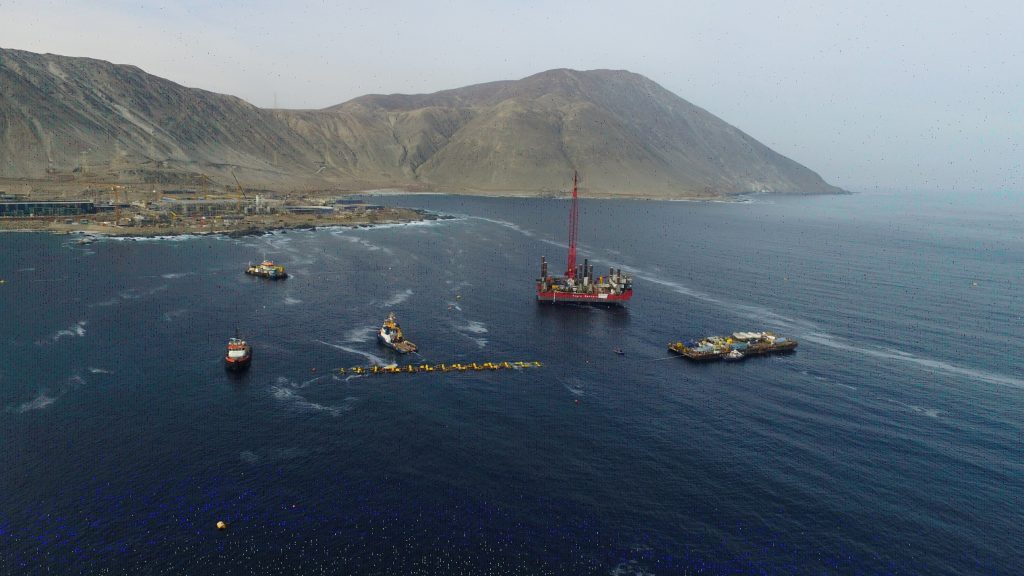
The further the cold water is from the coast, the longer the suction pipe (SWAC pipeline) must be, subject to high pressure and complex marine constraints. Its design, installation and safety require advanced expertise in underwater engineering.
These achievements show that the constraints associated with depth–pressure, currents, underwater topography, and corrosion can be overcome with the right materials (HDPE, titanium) and installation techniques (controlled immersion, ballasting, anchoring).
Unlike surface thalassothermy, which is often associated with heat pumps, deep SWAC provides direct cooling at very low temperatures, offering exceptional energy efficiency.
Geocean thus guarantees the safety, performance, and long-term profitability of each project.


✔ Depth is a key performance factor, but also a demanding technical challenge.
✔ Geocean has mastered this equation thanks to its international experience, concrete references, and excellence in marine engineering.
✔ SWAC is a mature technology that combines energy efficiency, low carbon emissions, and climate resilience.
Are you considering a SWAC project? Let’s talk.
Are you a local authority, hotel group, infrastructure manager, or industrial decision-maker with a coastal location? Assess the feasibility of a SWAC system for your buildings now.
📩 Contact the Geocean teams: info@geocean.com
🌐 Discover our projects: www.geocean.com/swac

Le 03 September 2026

Do you have a cooling and heating project? an offshore terminal decommissioning project? a gas terminal project?
Geocean, specialist in marine works, carries out your projects worldwide.