Geocean: connecting sea and shore to deliver water and energy infrastructure
Where sea meets shore lies one of the most demanding environments for infrastructure development. Currents, waves, geology, environmental constraints, port activities and difficult access can all converge within a relatively small area. This is precisely where Geocean has been operating for more than 40 years.
A marine contractor and a trademark of VINCI Construction Grands Projets, Geocean designs and delivers complex marine infrastructure providing access to water and energy. Its capabilities cover the full project lifecycle, from engineering and feasibility studies through to construction and offshore installation, with particular expertise in nearshore and shallow-water environments.
Our new corporate video provides a two-minute introduction to what defines Geocean: marine engineering grounded in field experience, a strong risk-management culture and three key areas of expertise serving water and energy infrastructure.

Marine projects designed around real site conditions
No two marine projects are alike. Water depth, geology, sea conditions, environmental requirements and shoreline configuration all influence the engineering and installation strategy.
Geocean therefore works with its clients from the earliest stages of a project. Feasibility studies, geotechnical and geophysical surveys, route definition, engineering, procurement, logistics, construction and marine installation are considered as part of one integrated approach.
Geocean can consequently deliver EPCI – Engineering, Procurement, Construction and Installation – projects, as well as concept engineering, project management support and transport and installation services. This approach combines more than four decades of marine project experience with access to the complementary expertise available across the VINCI Group.
Three areas particularly demonstrate Geocean’s ability to connect offshore infrastructure with onshore facilities.
Offshore gas terminals: connecting energy infrastructure to shore
Geocean designs and installs offshore gas terminals, including LNG infrastructure and floating FSRU terminals.
Such projects require the integration of several specialist disciplines: mooring systems, risers, subsea pipelines and shore approaches. Geocean’s capabilities range from mooring analysis and riser dynamic analysis to marine installation and landfall works using techniques including horizontal directional drilling, microtunnelling, cofferdams and open-trench solutions.
Geocean’s track record includes two offshore FSRU terminal projects in Bangladesh, as well as more recent marine energy projects in Wilhelmshaven, Germany, and offshore Congo.
The objective extends beyond installing offshore equipment. The challenge is to create a reliable connection between marine infrastructure and the energy networks located onshore.
SWAC: harnessing the ocean’s natural cooling capacity
The second area featured in the video is SWAC – Sea Water Air Conditioning.
The principle is straightforward: cold seawater available naturally at great depth is used as a renewable cooling source and transported to heat exchangers onshore. Geocean’s deep-water SWAC systems can draw seawater from depths approaching 1,000 metres.
By replacing much of the electricity traditionally required to generate cooling, SWAC can significantly reduce energy consumption. Geocean states that these systems can provide up to 90% energy savings compared with conventional cooling solutions.
Geocean has delivered three deep-water SWAC systems in French Polynesia: for The Brando hotel on Tetiaroa, the InterContinental in Bora Bora and the French Polynesia Hospital Centre in Papeete.
Together, these three projects now avoid approximately 10,800 tonnes of CO₂ emissions every year.
The SWAC system developed for the French Polynesia Hospital Centre demonstrates the scale at which the technology can operate. The installation provides 6 MW of cooling capacity and includes more than four kilometres of pipelines. Since entering operation, the system alone has reduced electricity consumption dedicated to hospital cooling by 8.7 GWh per year and avoids approximately 5,000 tonnes of CO₂ emissions annually.
Marine intake and outfall infrastructure: managing water between sea and shore
Geocean’s third core area of expertise covers hydraulic and environmental marine infrastructure, including seawater intakes, outfalls, subsea pipelines, diffusers and associated structures.
These systems are critical to desalination plants, wastewater treatment facilities and certain industrial and power-generation sites.
Geocean designs and installs complete marine intake and outfall systems, from intake heads to discharge diffusers. Depending on site conditions, solutions can incorporate HDPE or GRP pipelines and a range of shore-crossing techniques including trenching, microtunnelling and horizontal directional drilling.
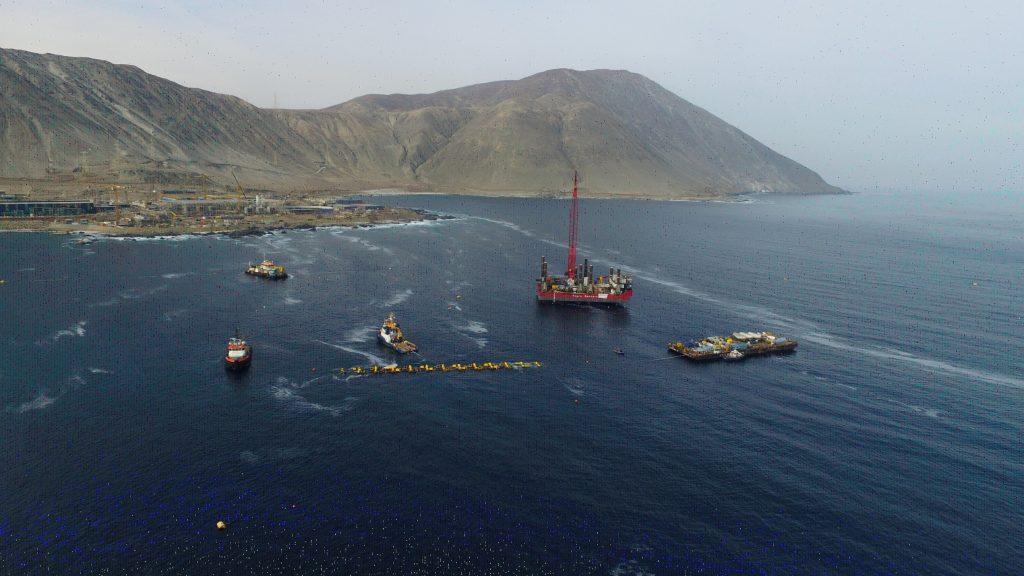
In Antofagasta, Chile, Geocean delivered marine intake and outfall infrastructure for a desalination plant. In Tahiti, the Punaauia project provides another example: a new 1.4-km subsea wastewater outfall designed to discharge treated water further offshore while helping protect the lagoon and coastline.
One common expertise: mastering the sea-to-shore interface
Offshore gas terminals, SWAC systems and marine hydraulic infrastructure address very different needs. Yet they share one fundamental engineering challenge: managing the complex interface where offshore becomes onshore.
This is where Geocean differentiates itself: combining engineering expertise, field experience, adaptability and risk management to turn demanding marine conditions into workable infrastructure solutions.
Discover Geocean’s expertise in our new corporate video and talk to our teams about your next marine infrastructure project.
Our latest news:
Case studies