Le 19 October 2026
In September, GEOCEAN’s managers took part in Lean Management training with the TEMPO team from VINCI Construction Grands Projets. A few weeks later, a visual management room was operational in Cassis, helping teams reach decisions more quickly.
Which bids are being prepared? Who is available to work on them? Which project milestone requires particular attention? From 7 to 9 September in Cassis, GEOCEAN’s management committee and key team members worked together on these everyday questions. With several bids and projects running simultaneously across several continents, the challenge is not simply to have the information, but to share it with the right teams at the right time so that decisions can be made collectively.
The objective of the training was to establish a simple, visual and collaborative system for managing activities, coordinating resources and making collective decisions. The approach supports GEOCEAN’s ongoing efforts to strengthen collaboration across its teams. It provides a common framework for discussion, from bid preparation through to the monitoring of projects in execution.
Lean is an approach to organising work that aims to eliminate waste that reduces efficiency at every level of a company, by involving the people who carry out the work. The programme combined an introduction to Lean, a serious game based on the Last Planner System, a collaborative planning method developed in the construction sector, and practical workshops.
The principle is straightforward: look differently at work we know inside out, identify bottlenecks and develop solutions with those who understand the operational constraints.
In this context, waste may take the form of waiting time, information that is difficult to locate or work that has to be repeated because coordination was insufficient. Making these issues visible allows teams to discuss their causes and ways to reduce them. Team involvement is essential: the people using the tools are best placed to assess whether they genuinely make their work easier and whether a new practice reflects the realities of their activities.
“The serious game was a turning point. In just a few hours, everyone saw the effect that late information can have across the entire chain, from the bid to the site.” — Roy Issa, Operations Director
The workshops extended this practical exercise by focusing on GEOCEAN’s own working methods. Participants examined which information needed to be shared, the appropriate planning horizons and the responsibilities required to keep the tools up to date. They also challenged existing habits: which practices should be retained, which should be adapted, and which exchanges could be simplified to prepare decisions more effectively?
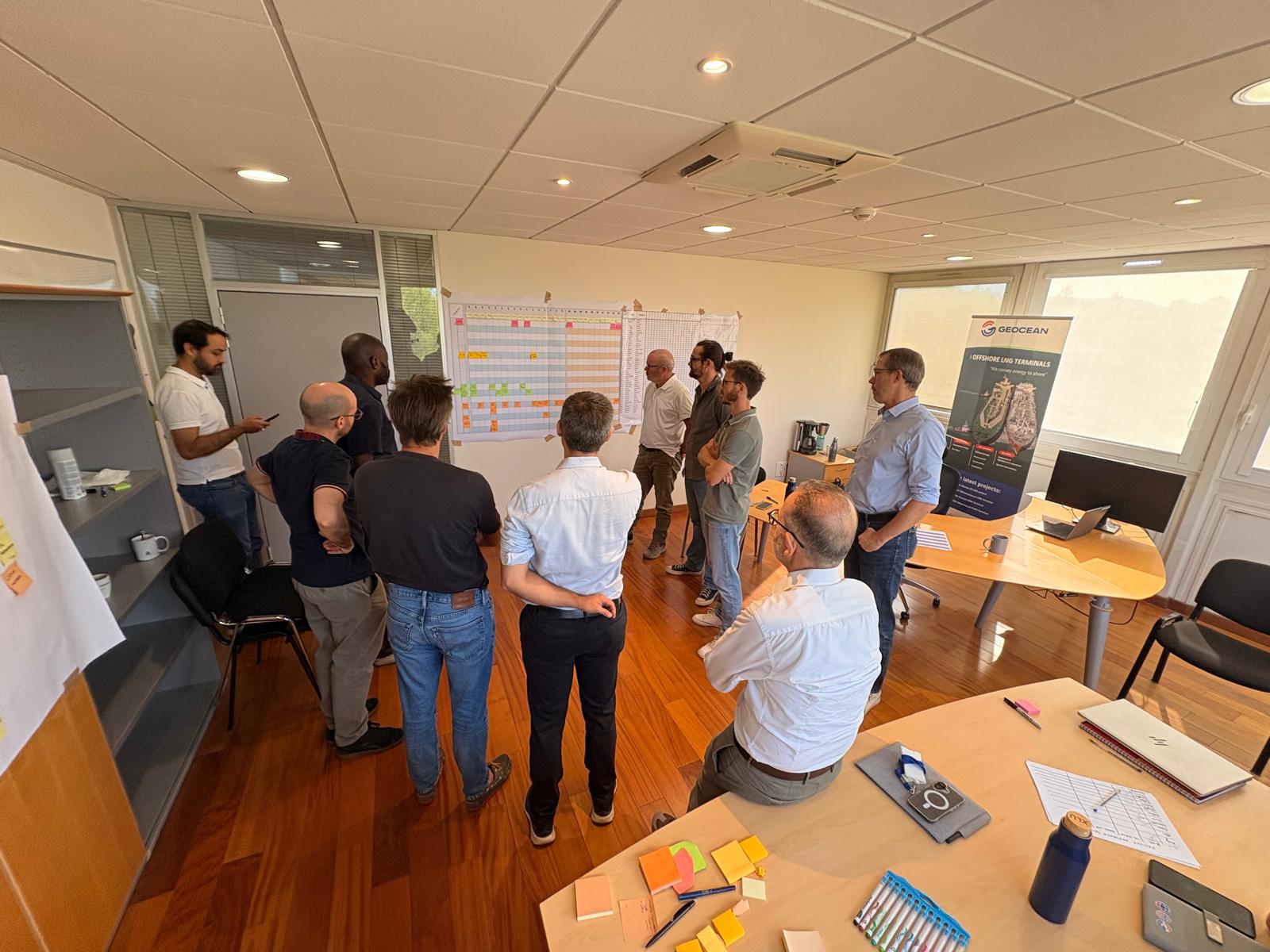
A shared planning board. Business development, bids, engineering studies, EPC projects and internal improvement actions are all monitored on a single tool, together with their milestones and planning horizons. The teams themselves defined the appropriate level of detail: enough to support coordination, while remaining clear enough to use during meetings. Milestones that depend on third parties, partners or clients are monitored in the same way as internal milestones. On a recent bid, this approach enabled us to identify a pending partner document early and adjust the decision timetable before it became critical.
This shared view connects deadlines that would otherwise be monitored by different stakeholders. Each milestone becomes a coordination point: what must be ready, the contributions expected and the dependencies to be monitored can all be discussed collectively. The clarity of the tool matters as much as its content, since it must support discussion without requiring teams to reconstruct the situation at every meeting.
Bids and available resources. Preparing a bid requires specialist input well before a project begins. The workload plan displayed in the visual management room compares current bids with team availability, discipline by discipline, so that resource decisions can be anticipated. On a recent bid in West Africa, pressure on a key capability was identified early enough to adjust the team without affecting the timetable.
The workshops on business development workload and resources explored the information required for this forward planning: bid submission dates, expected decisions, priorities and availability by discipline. The teams also worked on a bid preparation checklist to clarify the different stages, responsibilities and outstanding items. It complements the broader approach to monitoring progress and identifying bottlenecks.
A dashboard for projects in execution. Progress, engineering, procurement, fabrication, installation, HSE and quality: project reviews are based on a limited number of indicators selected for their practical value in supporting decisions.
The choice of indicators addresses a practical question: what information needs to be reviewed in order to decide on an action? The workshops considered both the data required for monitoring and how that data should be updated. A useful indicator should help teams understand a situation, identify a deviation or reveal the need for a decision. The aim is to focus attention on matters that require action.
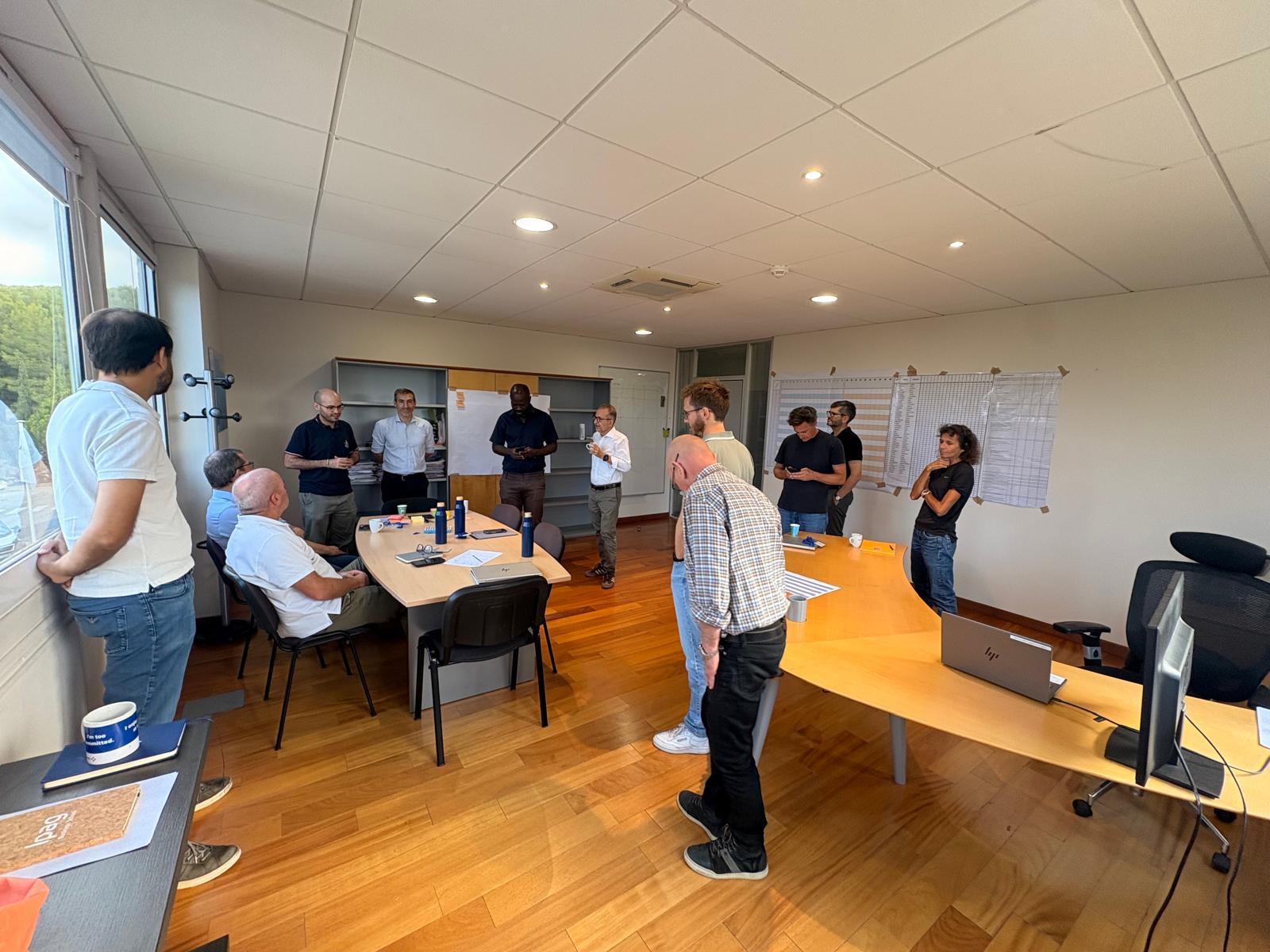
These tools are brought together in a visual management room at our Cassis offices. It has been operational since September, and the steering team meets there every Monday.
Reviewing existing routines has helped refocus each meeting on its purpose. Business development discussions are now brought together in a single review, where decisions can be made during the meeting with all the relevant information available.
Meeting preparation, participation and frequency form an integral part of the system. Using the same shared tool allows collective time to be focused on difficulties and decisions. It also provides continuity from one meeting to the next, enabling commitments to be monitored and responsibilities to be clearly identified.
“A board is only as valuable as the meeting that brings it to life. Today, when an issue is blocking progress, the whole team can see it and a decision is made within the week.” Roy Issa
The next challenge is to embed these practices over time: keeping the tools up to date, refining them through use and gradually involving all operational and financial teams. The approach is designed to support the collective performance of our marine projects.
Simplicity will remain a key measure of success: each tool must be easy to understand, update and use every day. Feedback from the teams will help adjust both the tools and the meetings as needs evolve. At GEOCEAN, practising Lean means maintaining the ability to look differently at familiar activities so that we can manage them better together.
Le 19 October 2026
Do you have a cooling and heating project? an offshore terminal decommissioning project? a gas terminal project?
Geocean, specialist in marine works, carries out your projects worldwide.