Le 03 September 2026
The harsh climatic conditions specific to this area between land and sea – strong winds, heavy swells, powerful currents, tides, sedimentary movements, etc. – put these installations to the test, requiring the choice of particularly durable infrastructure. In addition, the proximity to the coast and therefore to human activities means that very stringent safety standards must be taken into account. Finally, the significant cost of these installations requires particular attention to be paid to the choice of method to be implemented, with significant differences depending on the method chosen.
There are two infrastructure solutions for connecting these maritime terminals to the coast: infrastructure with so-called ‘overhead’ pipelines, such as jetties or quays, and infrastructure with so-called ‘submarine’ pipelines, installed on or under the seabed.
While around 75% of LNG export or import terminals worldwide are equipped with jetties or quays with overhead transfer systems, Geocean recommends the use of submarine pipelines and ship anchoring systems on the seabed when the ship is anchored more than 200 metres from the coast and less than 1,000 metres away. The aim of this article is to show why this choice, which is too often dismissed due to dogmatism or prejudice, may prove to be the most suitable for the specific constraints of a site.

Side anchoring system, connected to the ground by a pipeline
Jetties and quays require a large footprint and extensive infrastructure, with a visual impact that is often substantial and alters the coastal landscape. In contrast, terminals with underwater pipelines, installed several kilometers from the coast, have no impact on the landscape. The environmental impact can be further reduced through advanced techniques such as directional drilling and microtunnelling, which allow the pipeline to be installed in a tunnel under the seabed, minimizing disruption to marine habitats.

Example of a traditional jetty
The choice of infrastructure type depends mainly on the water depth available at the site intended to accommodate LNG carriers or FSRUs.
When the bathymetry allows ships to approach very close to the coast (less than 200 metres) without the need for dredging, quay and jetty systems are generally preferred.
Conversely, when the seabed slopes gently and the waters remain shallow for a long distance from the coastline (more than 1,000 metres), terminals equipped with submarine pipelines and ship anchoring systems on the seabed are logically the most popular.
Between these two configurations, both types of infrastructure can coexist.

At the Wilhelmshaven gas terminal, a jetty complements the 1.7 km long gas import pipeline installed by Geocean 14 metres below sea level to connect the Excelerate Excelsior FSRU to the German network.
For a long time, jetties were the preferred option, as the installation of subsea pipelines required specialised pipe-laying vessels, which were few in number and whose availability was uncertain. Jetties, requiring less complex and often locally available marine construction resources, were therefore a more accessible solution.
Over the past fifteen years or so, the emergence of innovative techniques has made it possible to install submarine pipelines several kilometres long without the need for a pipe-laying vessel, thereby significantly improving the economic competitiveness of this infrastructure compared to jetties. These techniques include pipe pulling (manufacturing the pipeline on land and pulling it into the sea) and the use of modular barges, which are much lighter than pipe-laying vessels.
Ship mooring systems can also be simplified: either through the traditional use of anchors, which are completely invisible and reusable, or, in the case of a channel where the footprint is limited, through the use of mooring dolphins.
However, CAPEX assessments now clearly favour pipeline solutions and underwater mooring systems in this zone between 200 and 1,000 metres from the coast.
In terms of OPEX, the two types of infrastructure have relatively similar costs, both for mooring support vessels and for infrastructure maintenance. However, the complete dismantling of the infrastructure – the cost of which is often overlooked at the time of investment – proves to be more advantageous for the subsea solution.
Another advantage of subsea systems is significantly reduced construction times. Lighter, requiring fewer engineering hours, based on available components, with little metal prefabrication and simplified authorisation procedures, some projects are completed in 12 months, an exceptional turnaround time in this sector that meets the needs of investors.

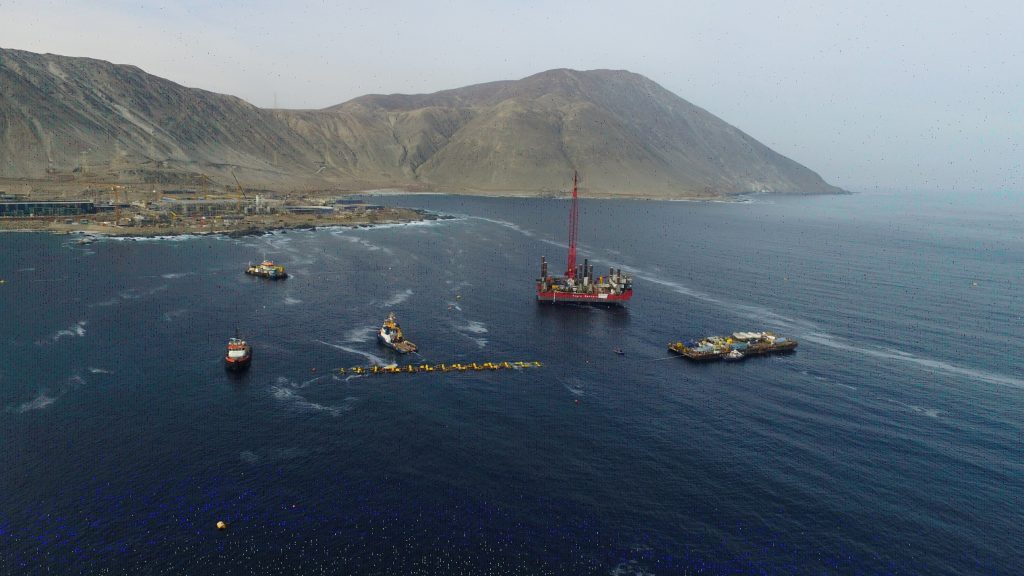
Pipelines installed by Geocean in shallow waters
Pose de canalisations sous-marines pour relier un terminal gazier offshore en Allemagne – à Wilhelmshaven
Dans le cadre d’un projet visant à relier un terminal gazier offshore à terre, Geocean a opté pour une conduite sous-marine afin de répondre à des exigences strictes en matière de coûts et de respect de l’environnement.
Défi : transporter du gaz sur 1,7 km avec une profondeur maximale de 14 m.
Solution : installation d’un réseau de pipeline TCP (Thermo composite pipe) renforcé avec un revêtement par des coquilles en fonte, puis mise en place d’un cofferdam pour relier la terre.
Résultat : réduction de coût très significative par rapport à une solution aérienne (+ de 60 %), mise en œuvre rapide, aucun impact sur le paysage.


Laying subsea pipelines to connect a gas terminal in Bangladesh – at Moheshkhali
Geocean carried out a complex project to install a 5 km long subsea pipeline with a diameter of 24″ to connect the FSRU to an onshore manifold.
Challenge: laying a pipeline in an unstable environment subject to extreme weather conditions (monsoon, very strong currents, high tidal range, etc.).
Solution: laying the pipeline on the seabed in the heart of a protected area (very low environmental impact) and constructing all the onshore infrastructure.
Additional benefits: reduced maintenance costs and greater resilience to natural hazards.

Le 03 September 2026

Do you have a cooling and heating project? an offshore terminal decommissioning project? a gas terminal project?
Geocean, specialist in marine works, carries out your projects worldwide.