10 YEARS IN BANGLADESH: TWO FSRU PROJECTS THAT ILLUSTRATE GEOCEAN’S DNA
Moheshkhali (Cox’s Bazar district), Bangladesh — Ten years ago, Geocean launched the study phase for two offshore regasification terminals that have become benchmarks: MLNG and SLNG.
Beyond their technical performance, these projects tell a story of execution close to the coastline, in a demanding environment. When the infrastructure does not yet exist, success depends on a key capability: organizing, securing, and delivering.
On the occasion of this 10th anniversary, looking back on these achievements reminds us of what sets us apart: connecting the sea and the land, and working in places where access conditions make each stage of infrastructure implementation complex.
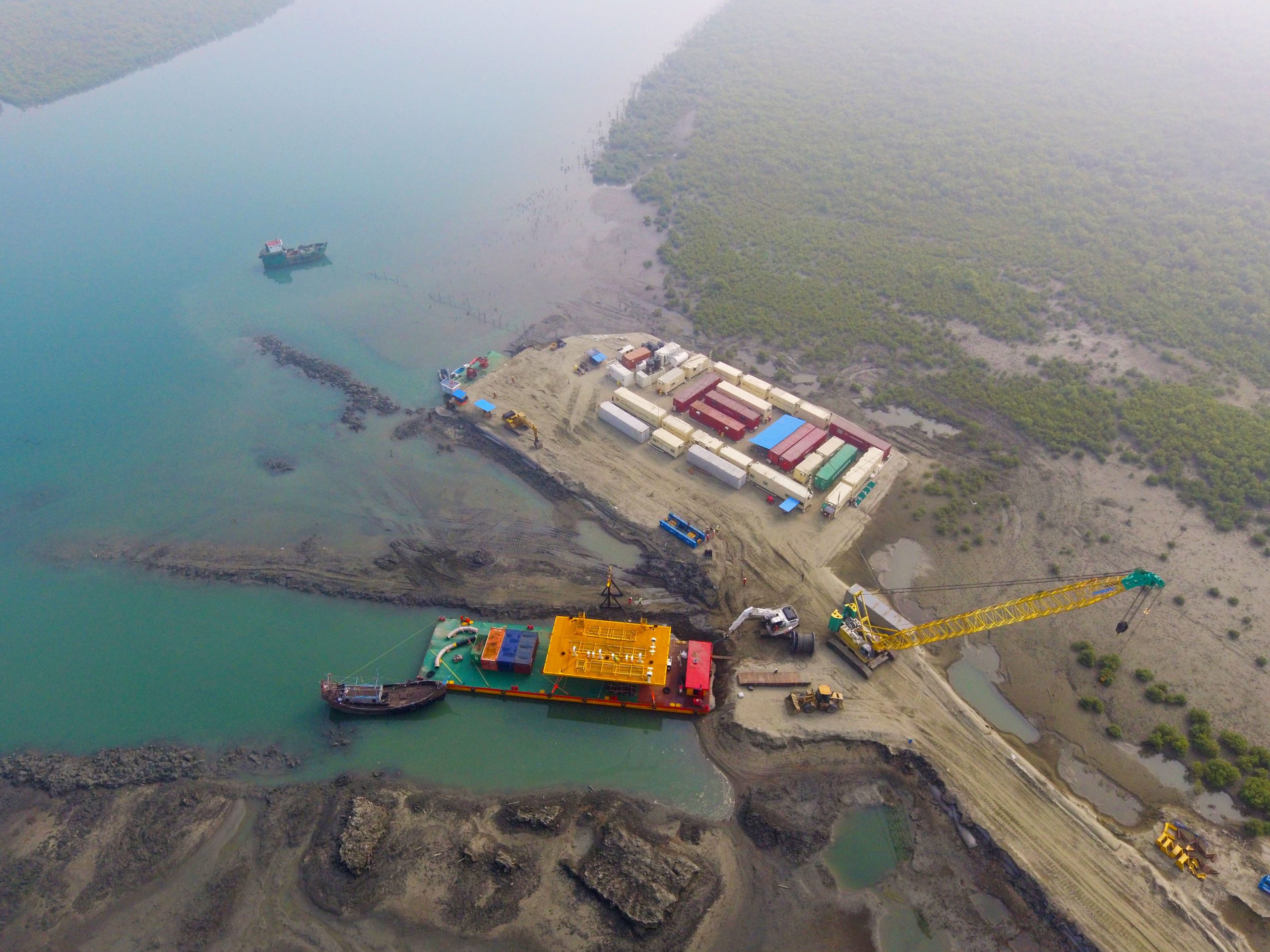
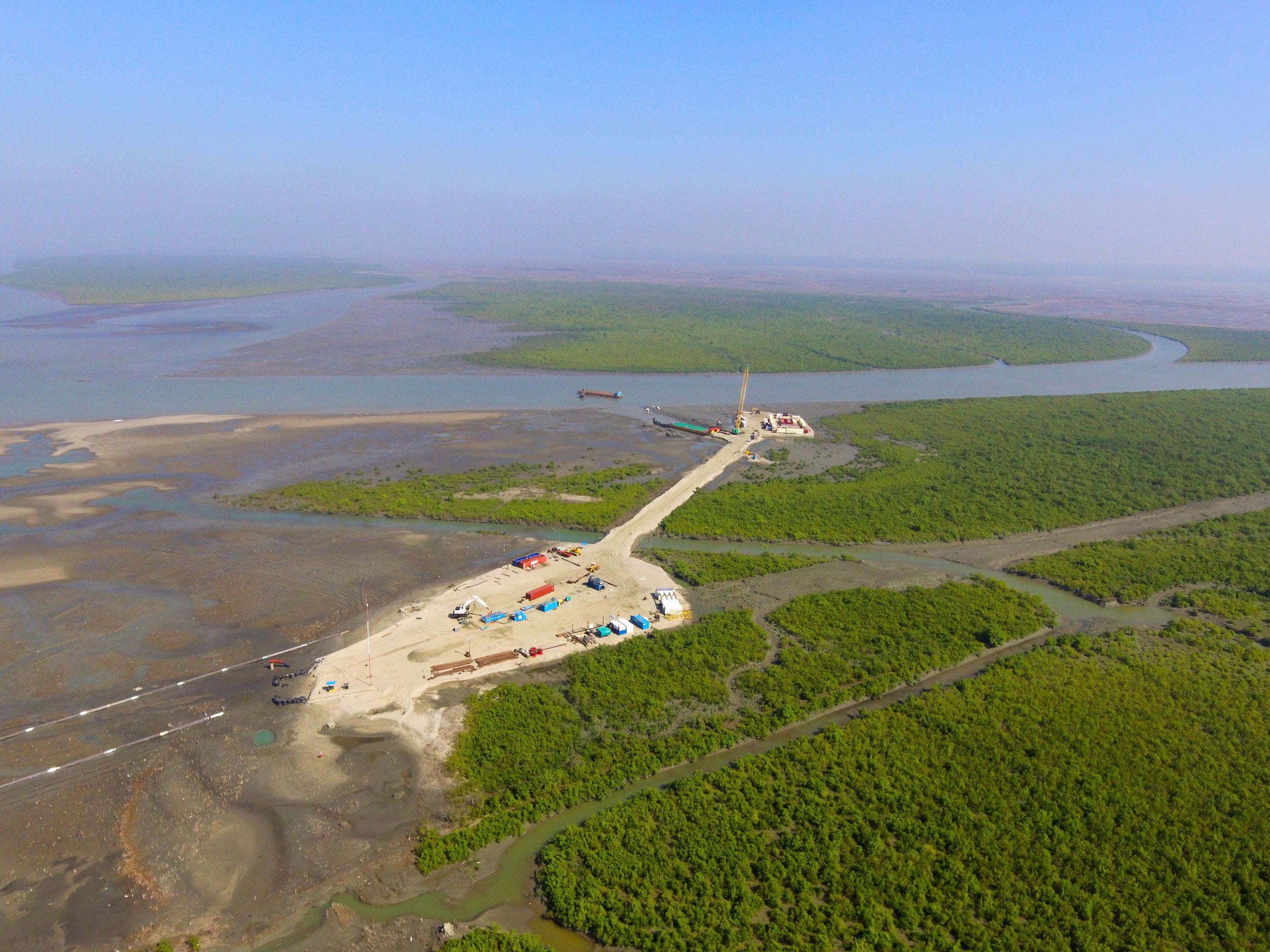
MLNG: FIRST FSRU TERMINAL COMPLETED IN JULY 2018 FOR EXCELERATE ENERGY
On the MLNG FSRU Terminal project (client: Excelerate Energy), Geocean carried out an EPCI contract in Moheshkhali over the period 2017–2018, including the installation of an FSRU mooring solution and the construction of an import gas line.
- Completion date: July 2018.
- Scope highlights (selection)
- Import gas line 24’’ — 7,500 m, up to 40 m depth
- PLUG Mooring System
- 8 suction piles and 3 holdback anchors
- Installation sequence including dredging, landfall, pipe laying and burial, PLEM/spools, risers/umbilicals, then pre-commissioning and commissioning assistance
This project laid the foundations for robust execution in a complex coastal environment: sea/land interface, multi-trade coordination, and control of operations in real conditions.
In a context where port infrastructure was limited, the teams also set up a “coast-to-site” logistics chain: a receiving and temporary storage area as close as possible to the shore, appropriate means for shore pull and transfers, and careful management of weather/tide windows. This organization secured the flow of materials and the continuity of operations, starting with MLNG.
SLNG: A CONFIRMED REFERENCE, COMPLETED IN FEBRUARY 2019 FOR SUMMIT GROUP
The SLNG FSRU Terminal project (client: Summit) is a continuation of this work, with an EPCI contract in Moheshkhali for the period 2017–2019.
- Completion date: February 2019.
- Scope highlights (selection)
- Import gas line 24’’ — 6,500 m, up to 40 m deep
- PLUG8 mooring system with suction piles and 3 holdback anchors
- Full range of activities: surveys (bathymetry, geophysics, geotechnics), engineering, procurement, construction & installation, pre-commissioning and commissioning assistance[NP1] based on the MLNG execution plan and feedback immediately incorporated
These two projects have reinforced one conviction: on an FSRU terminal, performance is not limited to execution—it depends on the ability to orchestrate the whole. The second terminal was delivered in synergy with the first, capitalizing on the execution plan established for MLNG, refining it, and immediately integrating lessons learned.
WHAT MADE THE DIFFERENCE IN THE FIELD: DELIVERING WHERE NOTHING IS READY
The Bangladeshi coastline presents constraints that are typical of our operating environments: currents of up to 5 knots, a seismic zone, exposure to cyclones/hurricanes, tides of up to 4 m, and heavy sedimentation from the Himalayas, resulting in changing bathymetry. Added to this, at the time, was the lack of robust port infrastructure to secure large-scale project logistics: all factors that left no room for improvisation.
This reality made the organization of the construction site crucial. The “shore-to-site” supply chain set up at MLNG was then replicated and reinforced at the second terminal, capitalizing on the execution plan and immediately incorporating lessons learned. Interface management, secure transfers, and careful management of weather/tide windows: all these factors contributed to maintaining operational continuity despite a particularly challenging environment.
This proximity had very concrete effects:
• reduced transit times and improved operational continuity,
• enhanced cohesion between all nationalities involved,
• an efficient schedule of daily debriefings, as close as possible to operations.
In remote and undeveloped areas, this type of organization is not a detail: it is a lever for performance and control.
PROVEN EXPERTISE, RELEVANT FOR NEW CHALLENGES
These references illustrate several of Geocean’s structural strengths:
• Agility & flexibility: a small team capable of adapting quickly to local constraints and field contingencies.
• Upstream risk management: a structured approach from the early stages to ensure feasibility and reduce execution risks.
• Modular barge solutions: configurations adapted to the site and modular according to the specificities of the project
• Synergies: an ability to integrate and coordinate interfaces, both onshore and offshore, with local and regional players.
It is this combination—technical expertise, field organization, and a culture of control—that makes Geocean fully qualified to operate in Bangladesh and other comparable environments.
Conclusion
Ten years after the launch of the studies, MLNG and SLNG remain solid references: two completed FSRU projects ensuring daily gas delivery to Bangladesh’s networks, carried out in a demanding area, and revealing key expertise—connecting sea and land with controlled execution.
Building on these references, we remain committed to supporting new projects, both in Bangladesh and in all territories where new challenges must be met to bring energy to local populations and contribute to the energy transition.
“We connect land and sea for a sustainable energy future.”
